Stem Cell TherapyApplications pending doctor confirmation
Stem Cell Therapy
Stem cell therapy is a broad term for treatments that use cells capable of renewing themselves or developing into specialized cells. Some blood-forming stem cell treatments are established for selected blood and immune conditions, while many products marketed for musculoskeletal, neurological, metabolic or other regenerative uses remain investigational or unapproved in major regulatory systems. This page does not claim that Dr. Naveed treats any specific condition with stem cells.
Educational planning information. Individual advice follows examination and review of investigations. Consultations are available in Rawalpindi for patients from Rawalpindi and Islamabad.
Clinical focusCell-based and regenerative medicine assessment
01Applications currently confirmed for publication02Cell-based and regenerative medicine assessment03Stem Cell Therapy
Procedure-specific visual guideWhy choose Dr. Naveed
Experienced surgical judgement for Stem Cell Therapy
Clear diagnosis, realistic treatment planning and careful follow-up from a consultant surgeon whose clinical practice is shaped by academic teaching and military medical service.
01 · Understanding the therapy
What Stem Cell Therapy is designed to achieve
No condition-specific stem cell application has yet been confirmed by Dr. Naveed for publication on this website. Before any service is represented, the clinic must confirm the diagnosis addressed, cell source and product, preparation, route of administration, treating team, evidence, regulatory status and follow-up pathway. An appointment request is therefore a request for assessment and verification—not a promise that treatment is offered or suitable.
Stem cell therapy is a broad term for treatments that use cells capable of renewing themselves or developing into specialized cells. Some blood-forming stem cell treatments are established for selected blood and immune conditions, while many products marketed for musculoskeletal, neurological, metabolic or other regenerative uses remain investigational or unapproved in major regulatory systems. This page does not claim that Dr. Naveed treats any specific condition with stem cells.
02 · Applications and suitability
Clinical applications considered for Stem Cell Therapy
No condition-specific application is listed as available until it has been confirmed by the doctor and reviewed against current evidence and regulation.
Applications currently confirmed for publication
No condition-specific stem cell application has yet been confirmed by Dr. Naveed for publication on this website. Before any service is represented, the clinic must confirm the diagnosis addressed, cell source and product, preparation, route of administration, treating team, evidence, regulatory status and follow-up pathway. An appointment request is therefore a request for assessment and verification—not a promise that treatment is offered or suitable.
A qualified clinician has confirmed the diagnosis and reviewed…
A qualified clinician has confirmed the diagnosis and reviewed established alternatives
The exact cell product and intended application are clearly…
The exact cell product and intended application are clearly identified
The regulatory
The regulatory, ethics and clinical-governance requirements for the relevant jurisdiction are satisfied
03 · Patient considerations
Questions that shape suitability for Stem Cell Therapy
No symptom or diagnosis automatically makes a patient suitable for stem cell therapy
The underlying condition must first be confirmed using established clinical assessment
Patients should be cautious when a product is promoted as treating many unrelated diseases
Urgent or progressive symptoms require standard medical assessment rather than delay for an unverified regenerative treatment
An appointment is an assessment, not a promise that treatment is appropriate or available. Established care should not be delayed for an unconfirmed regenerative application.
04 · Evidence context
Why stem cell applications require condition-specific evidence
- 01
The term ‘stem cell therapy’ can describe very different cell sources, processing methods and levels of evidence
- 02
Autologous, donor-derived, cord-blood, fat-derived and other products are not interchangeable
- 03
Investigational applications may have uncertain dose, durability, comparative benefit and long-term safety
- 04
Regulatory status differs by product, intended use and country; approval in one context does not validate every application
05 · Safety considerations
Safety context considered before Stem Cell Therapy
The term ‘stem cell therapy’ can describe very different…
The term ‘stem cell therapy’ can describe very different cell sources, processing methods and levels of evidence
Autologous
Autologous, donor-derived, cord-blood, fat-derived and other products are not interchangeable
Investigational applications may have uncertain dose
Investigational applications may have uncertain dose, durability, comparative benefit and long-term safety
Regulatory status differs by product
Regulatory status differs by product, intended use and country; approval in one context does not validate every application
06 · Assessment
How suitability for Stem Cell Therapy is assessed
Suitability assessment starts with a confirmed diagnosis and review of established treatment options. The clinician must identify the exact product, cell source, processing, sterility controls, intended mechanism, delivery route, evidence, regulatory or ethics oversight, operator qualifications and adverse-event plan. Relevant blood tests, imaging or specialist opinions depend on the underlying condition. No treatment decision should be based on marketing claims alone.
Clinical history
Suitability assessment starts with a confirmed diagnosis and review of established treatment options.
Focused examination
The clinician must identify the exact product, cell source, processing, sterility controls, intended mechanism, delivery route, evidence, regulatory or ethics oversight, operator qualifications and adverse-event plan.
Laboratory testing
Relevant blood tests, imaging or specialist opinions depend on the underlying condition.
Imaging
No treatment decision should be based on marketing claims alone.
Special investigations
Any endoscopy, tissue sampling, vascular study or other specialist test is selected for the clinical question raised by applications currently confirmed for publication; not every patient needs every test.
07 · Treatment options
Treatment choices before and alongside Stem Cell Therapy
Established treatment, rehabilitation, observation or a carefully governed investigational option may be discussed according to diagnosis and evidence.
Non-surgical option 01
Established evidence-based treatment for the diagnosed condition
Surgical treatment
Observation, rehabilitation, medicines or surgery where clinically appropriate
Non-surgical option 03
A regulated clinical trial with transparent protocol and oversight for an investigational application
Non-surgical option 04
A specifically confirmed and lawfully governed cell-based treatment when supported by evidence
Surgical treatment
No cell-based treatment when the product, indication, evidence or safety pathway is unclear
08 · Treatment considerations
When Stem Cell Therapy may be considered
Therapy is considered only after the proposed application, evidence status, regulatory position, alternatives and individual risks have been verified.
- A qualified clinician has confirmed the diagnosis and reviewed established alternatives
- The exact cell product and intended application are clearly identified
- The regulatory, ethics and clinical-governance requirements for the relevant jurisdiction are satisfied
- Potential benefits, uncertainty, alternatives, costs and known and unknown risks are explained without cure claims
- Independent review supports proceeding rather than delaying proven care
09 · Treatment pathway
The Stem Cell Therapy care pathway
Consultation
Discuss symptoms, priorities, previous care and relevant reports before deciding whether Stem Cell Therapy is appropriate.
Diagnosis
Suitability assessment starts with a confirmed diagnosis and review of established treatment options.
Preparation
The exact clinical application, evidence status, product, route, medicines and monitoring requirements must be verified before Stem Cell Therapy.
Treatment
Cells may be collected from the patient or a donor depending on the confirmed therapy Processing and quality controls must match the product and regulatory pathway
Monitoring
Recovery and follow-up cannot be stated generically because they depend on the confirmed product, collection method, delivery route and underlying condition.
Follow-up
Symptoms, safety and any agreed outcomes are reviewed without assuming benefit; established clinical care continues as indicated.
10 · Treatment approach
How Stem Cell Therapy may be performed
- 01
Cells may be collected from the patient or a donor depending on the confirmed therapy
- 02
Processing and quality controls must match the product and regulatory pathway
- 03
Administration may be intravenous, local or another route according to a specific approved protocol
- 04
Monitoring should include immediate adverse effects and longer-term follow-up appropriate to the product
- 05
No collection, processing or administration method is represented here as offered by Dr. Naveed until formally confirmed
What Stem Cell Therapy aims to improve
- An established cell therapy may provide a clinically supported benefit for its specific approved indication
- Investigational research may help determine whether a regenerative application is safe and effective
- A structured assessment can protect patients from unsuitable or poorly characterized products
- Potential benefit must be described for one confirmed product and indication—not generalized to all stem cells
- Benefit, improvement or cure cannot be guaranteed
Balanced consent for Stem Cell Therapy
- Infection, contamination, immune reaction, bleeding or pain related to collection or administration
- Cells behaving unpredictably, including abnormal tissue growth or tumour formation
- Neurological, vascular, inflammatory or organ-specific complications depending on route
- Failure to help, temporary effect or worsening of the underlying condition
- Financial harm or delay of effective established treatment
- Unknown long-term effects, particularly for investigational products
No regenerative treatment can guarantee an outcome. Risk and uncertainty depend on the exact product, source, processing, route, diagnosis and regulatory status.
13 · Follow-up timeline
Follow-up checkpoints after Stem Cell Therapy
Recovery and follow-up cannot be stated generically because they depend on the confirmed product, collection method, delivery route and underlying condition. A responsible plan specifies observation, wound or injection-site care, activity, medicines, adverse-event contacts and scheduled clinical review. Investigational treatment should include protocol-defined safety monitoring. These checkpoints are planning prompts—not promises—and the treating team’s instructions take priority.
Week 1
Recovery and follow-up cannot be stated generically because they depend on the confirmed product, collection method, delivery route and underlying condition. Early priorities include pain control, safe movement and the first wound or procedure check when advised.
Week 2
Keep a written record of the product, source, batch or processing information and treating facility Activity still follows the individual discharge plan.
Week 4
Follow the condition-specific monitoring plan and do not stop established medicines without instruction Return to work or exercise depends on the procedure and job demands.
Week 6
Report new or worsening symptoms promptly A slower or faster course can both be normal depending on the operation.
Long-term
An established cell therapy may provide a clinically supported benefit for its specific approved indication Ongoing surveillance or specialist follow-up is arranged when the diagnosis requires it.
14 · Preparation
Preparing safely for Stem Cell Therapy
01
Bring the complete record
Take reports, imaging, pathology and details of previous treatment relevant to applications currently confirmed for publication.
02
Review medicines and allergies
Share prescribed medicines, blood thinners, diabetes treatment, supplements and allergies. Do not stop treatment without clinical instruction.
03
Complete pre-operative checks
Suitability assessment starts with a confirmed diagnosis and review of established treatment options.
04
Follow application-specific instructions
Do not assume fasting, medicine changes or a particular collection or delivery method. Follow only the instructions issued after the exact clinical plan has been confirmed.
05
Plan the treatment setting
Confirm the licensed treatment setting, responsible clinical team, monitoring arrangements and emergency contact before proceeding.
06
Know the recovery plan
Ask about wounds, bathing, diet, lifting, driving, work, exercise and the warning signs specific to Stem Cell Therapy.
15 · Monitoring and follow-up
Monitoring after Stem Cell Therapy
Any follow-up plan must be specific to the confirmed product, route and clinical application. New or worsening symptoms require prompt medical review.
- Keep a written record of the product, source, batch or processing information and treating facility
- Follow the condition-specific monitoring plan and do not stop established medicines without instruction
- Report new or worsening symptoms promptly
- Seek urgent care for breathing difficulty, severe allergic symptoms, high fever, neurological change, chest pain or rapidly worsening illness
- Attend all planned short- and long-term safety reviews
- Ask how adverse events are recorded and reported within the relevant regulatory system
16 · Patient questions
Frequently asked questions about Stem Cell Therapy
Ten procedure-specific answers to support a more informed consultation.
01Which conditions does Dr. Naveed treat with stem cell therapy?+
No condition-specific application has yet been confirmed for publication. The clinic must verify whether any service is offered before the website lists a condition or treatment claim.
02Is every stem cell treatment established medicine?+
No. Blood-forming stem cell transplantation is established for selected conditions, while many regenerative applications remain investigational or unapproved.
03Does using my own cells make treatment risk-free?+
No. Collection, processing, contamination, delivery route, abnormal cell behaviour and delay of effective care can still create risk.
04How can I check whether a proposed treatment is legitimate?+
Ask for the exact product, indication, evidence, regulator or ethics oversight, clinician qualifications, consent document, adverse-event plan and alternatives. Verify these independently where possible.
05Can stem cell therapy guarantee regeneration or cure?+
No. A responsible clinician should describe evidence and uncertainty for one specific indication and product without promising regeneration, recovery or cure.
06How is the need for Stem Cell Therapy confirmed?+
Suitability assessment starts with a confirmed diagnosis and review of established treatment options. The clinician must identify the exact product, cell source, processing, sterility controls, intended mechanism, delivery route, evidence, regulatory or ethics oversight, operator qualifications and adverse-event plan. Relevant blood tests, imaging or specialist opinions depend on the underlying condition. No treatment decision should be based on marketing claims alone.
07When might Stem Cell Therapy be considered?+
A qualified clinician has confirmed the diagnosis and reviewed established alternatives The exact cell product and intended application are clearly identified
08Are there alternatives to Stem Cell Therapy?+
Established evidence-based treatment for the diagnosed condition Observation, rehabilitation, medicines or surgery where clinically appropriate A regulated clinical trial with transparent protocol and oversight for an investigational application
09What anaesthesia may be used for Stem Cell Therapy?+
Depends on the confirmed product, collection and delivery route. This cannot be finalized until the exact application, product and route have been confirmed by the doctor.
10How long might I stay in hospital after Stem Cell Therapy?+
Not stated until the exact application and treatment setting are confirmed. The care setting and monitoring plan must be confirmed for the exact application before treatment is represented as available.
Authoritative patient-information referencesGeneral education supporting this procedure guide.
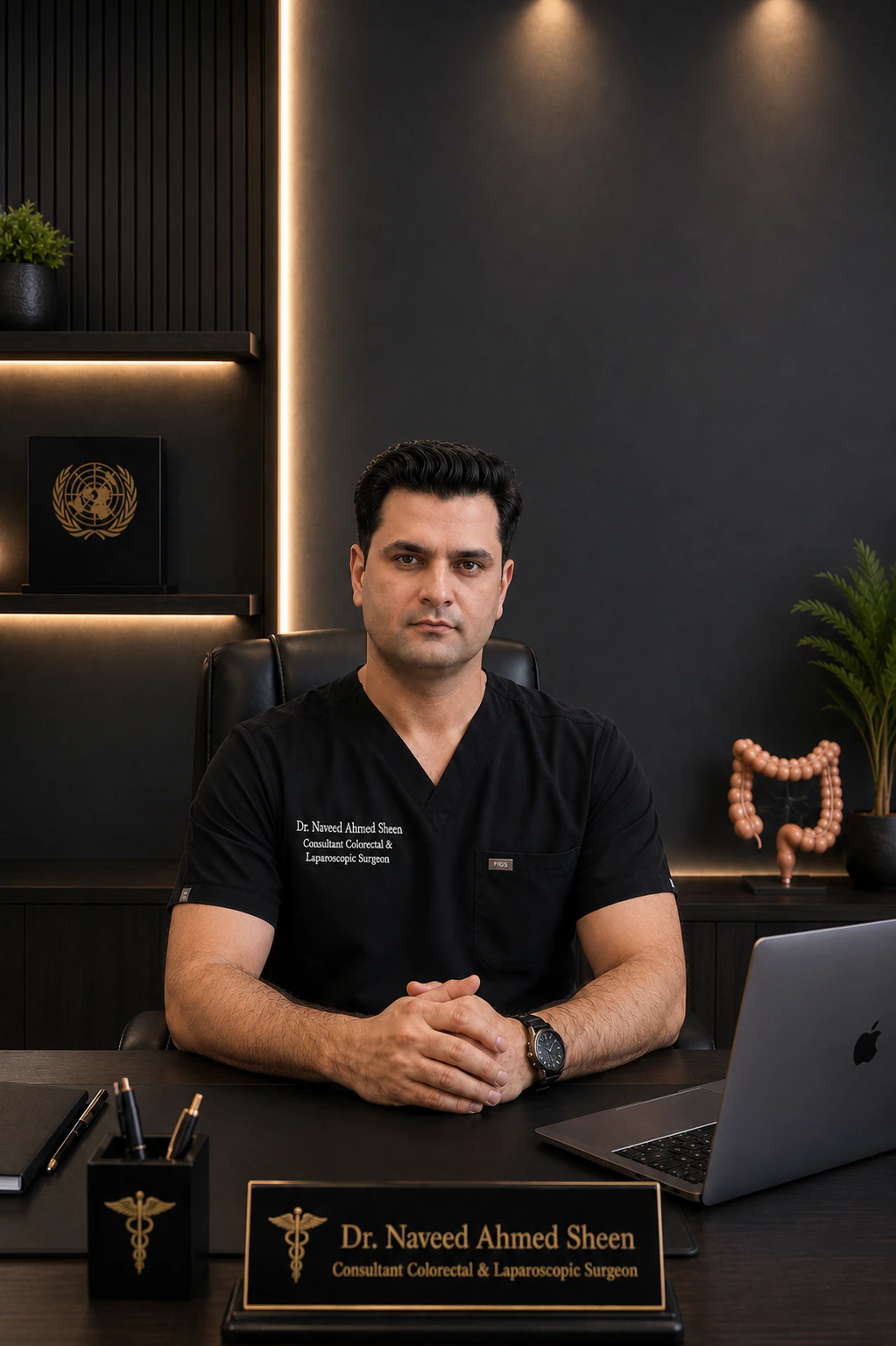
17 · Meet your consultant
Dr. Naveed Ahmed Sheen
Consultant Colorectal & Laparoscopic SurgeonAssistant Professor and Major (Retired), combining 15+ years of surgical experience with academic teaching, military medical service and a patient-centred approach.
- MRCS · Dip (AFPGMI) · CHPE
- 1000+ successful surgeries
- 5000+ patients treated
Confidential clinical assessmentDiscuss Stem Cell Therapy
Discuss Stem Cell Therapy
with Dr. Naveed
Bring your symptoms, reports and questions for a diagnosis-led discussion of appropriate options, benefits, risks and follow-up planning.