Body Contouring Procedures
Tummy Tuck (Abdominoplasty)
Abdominoplasty, commonly called a tummy tuck, removes selected excess lower-abdominal skin and fat and may tighten separated or weakened abdominal muscles. It is body-contouring surgery, not a treatment for obesity or a substitute for weight loss.
Educational planning information. Individual advice follows examination and review of investigations. Consultations are available in Rawalpindi for patients from Rawalpindi and Islamabad.
Clinical focusAbdominal and body contour
01Abdominal skin and muscle laxity02Abdominal and body contour03Body Contouring Procedures
Procedure-specific visual guideWhy choose Dr. Naveed
Experienced surgical judgement for Tummy Tuck (Abdominoplasty)
Clear diagnosis, realistic treatment planning and careful follow-up from a consultant surgeon whose clinical practice is shaped by academic teaching and military medical service.
01 · Understanding the procedure
What Tummy Tuck (Abdominoplasty) is designed to achieve
Pregnancy, major weight change, ageing and previous surgery can leave loose skin, stretch marks, a lower-abdominal fold or separation of the rectus muscles. The operation is tailored to the amount and position of excess tissue, existing scars, muscle laxity and the patient’s goals.
Abdominoplasty, commonly called a tummy tuck, removes selected excess lower-abdominal skin and fat and may tighten separated or weakened abdominal muscles. It is body-contouring surgery, not a treatment for obesity or a substitute for weight loss.
02 · Conditions treated
Conditions and clinical situations addressed by Tummy Tuck (Abdominoplasty)
The exact indication is confirmed from symptoms, examination and appropriate investigations.
Abdominal skin and muscle laxity
Pregnancy, major weight change, ageing and previous surgery can leave loose skin, stretch marks, a lower-abdominal fold or separation of the rectus muscles. The operation is tailored to the amount and position of excess tissue, existing scars, muscle laxity and the patient’s goals.
Weight has been stable and excess skin or muscle…
Weight has been stable and excess skin or muscle laxity remains significant
The patient understands the permanent scar
The patient understands the permanent scar, recovery and limits of the result
Medical assessment suggests that anaesthesia and wound risks are…
Medical assessment suggests that anaesthesia and wound risks are acceptable
03 · Symptoms
Symptoms that may lead to a Tummy Tuck (Abdominoplasty) consultation
Loose or overhanging abdominal skin after pregnancy or weight loss
Skin irritation or hygiene difficulty beneath a persistent fold
Abdominal wall laxity or muscle separation confirmed on examination
Concern about contour that persists despite stable weight and exercise
Symptoms can overlap with other conditions. Severe, rapidly worsening or emergency symptoms require urgent medical assessment.
04 · Causes
Why the condition behind Tummy Tuck (Abdominoplasty) may develop
- 01
Pregnancy and stretching of the abdominal wall
- 02
Substantial weight loss leaving redundant skin
- 03
Age-related loss of skin elasticity
- 04
Previous abdominal surgery and individual tissue quality
05 · Risk factors
Risk context considered before Tummy Tuck (Abdominoplasty)
Pregnancy and stretching of the abdominal wall
Pregnancy and stretching of the abdominal wall
Substantial weight loss leaving redundant skin
Substantial weight loss leaving redundant skin
Age-related loss of skin elasticity
Age-related loss of skin elasticity
Previous abdominal surgery and individual tissue quality
Previous abdominal surgery and individual tissue quality
06 · Diagnosis
How the need for Tummy Tuck (Abdominoplasty) is assessed
Consultation assesses general health, weight stability, smoking, medicines, previous scars, hernias, muscle separation, skin quality and expectations. Pregnancy plans and blood-clot risk are important. Imaging is not routinely required unless a hernia or another abdominal condition is suspected.
Clinical history
Consultation assesses general health, weight stability, smoking, medicines, previous scars, hernias, muscle separation, skin quality and expectations.
Focused examination
Pregnancy plans and blood-clot risk are important.
Laboratory testing
Imaging is not routinely required unless a hernia or another abdominal condition is suspected.
Imaging
Imaging is chosen when it can define anatomy, disease extent or an alternative explanation for the symptoms.
Special investigations
Any endoscopy, tissue sampling, vascular study or other specialist test is selected for the clinical question raised by abdominal skin and muscle laxity; not every patient needs every test.
07 · Treatment options
Treatment choices before and alongside Tummy Tuck (Abdominoplasty)
Observation, lifestyle measures, medical care, a focused procedure or surgery may be considered according to the confirmed diagnosis.
Surgical treatment
No surgery, with exercise and weight management for general health
Non-surgical option 02
Treatment of skin irritation and support garments
Non-surgical option 03
Liposuction alone when skin is elastic and the issue is localized fat
Non-surgical option 04
Mini-abdominoplasty for selected lower-abdominal excess
Surgical treatment
Full abdominoplasty, sometimes combined with carefully limited liposuction
08 · Surgical indications
When Tummy Tuck (Abdominoplasty) may be recommended
Surgery is discussed only when the diagnosis, expected benefit, alternatives and individual risks support intervention.
- Weight has been stable and excess skin or muscle laxity remains significant
- The patient understands the permanent scar, recovery and limits of the result
- Medical assessment suggests that anaesthesia and wound risks are acceptable
- Future pregnancy and major further weight loss are not planned
09 · Procedure overview
The Tummy Tuck (Abdominoplasty) care pathway
Consultation
Discuss symptoms, priorities, previous care and relevant reports before deciding whether Tummy Tuck (Abdominoplasty) is appropriate.
Diagnosis
Consultation assesses general health, weight stability, smoking, medicines, previous scars, hernias, muscle separation, skin quality and expectations.
Preparation
The team reviews medicines, anaesthetic readiness and procedure-specific instructions for Tummy Tuck (Abdominoplasty).
Procedure
A low transverse incision allows excess skin and fat to be removed The umbilicus may be repositioned during a full abdominoplasty
Recovery
Walking is encouraged early, but the abdomen may feel tight and standing fully upright can be uncomfortable at first.
Follow-up
Healing, symptoms and the result of Tummy Tuck (Abdominoplasty) are reviewed, with further care arranged when clinically necessary.
10 · Operative approach
How Tummy Tuck (Abdominoplasty) may be performed
- 01
A low transverse incision allows excess skin and fat to be removed
- 02
The umbilicus may be repositioned during a full abdominoplasty
- 03
Separated abdominal muscles may be tightened when clinically appropriate
- 04
Drains or progressive-tension sutures may be used according to the operation
What Tummy Tuck (Abdominoplasty) aims to improve
- Removal of selected redundant skin and improvement in abdominal contour
- Possible improvement in irritation and hygiene beneath a skin fold
- Repair of clinically assessed muscle laxity
- A result that can be maintained with stable weight and healthy habits
Balanced consent for Tummy Tuck (Abdominoplasty)
- Bleeding, infection, blood clots and anaesthetic complications
- Seroma, delayed wound healing or skin loss, especially with smoking
- Permanent lower-abdominal scar, altered sensation and asymmetry
- Unsatisfactory contour, prominent scarring or need for revision
No operation can guarantee an outcome. Personal risk depends on diagnosis, anatomy, health and the final technique.
13 · Recovery timeline
Recovery checkpoints after Tummy Tuck (Abdominoplasty)
Walking is encouraged early, but the abdomen may feel tight and standing fully upright can be uncomfortable at first. Compression may be advised. Many patients need several weeks away from strenuous work and exercise; full recovery commonly takes around six weeks but varies with the extent of surgery and healing. These checkpoints are planning prompts—not promises—and the treating team’s instructions take priority.
Week 1
Walking is encouraged early, but the abdomen may feel tight and standing fully upright can be uncomfortable at first. Early priorities include pain control, safe movement and the first wound or procedure check when advised.
Week 2
Follow drain, dressing and compression-garment instructions Activity still follows the individual discharge plan.
Week 4
Avoid smoking and heavy lifting during healing Return to work or exercise depends on the procedure and job demands.
Week 6
Maintain hydration, protein intake and gentle walking A slower or faster course can both be normal depending on the operation.
Long-term
Removal of selected redundant skin and improvement in abdominal contour Ongoing surveillance or specialist follow-up is arranged when the diagnosis requires it.
14 · Preparation
Preparing safely for Tummy Tuck (Abdominoplasty)
01
Bring the complete record
Take reports, imaging, pathology and details of previous treatment relevant to abdominal skin and muscle laxity.
02
Review medicines and allergies
Share prescribed medicines, blood thinners, diabetes treatment, supplements and allergies. Do not stop treatment without clinical instruction.
03
Complete pre-operative checks
Consultation assesses general health, weight stability, smoking, medicines, previous scars, hernias, muscle separation, skin quality and expectations.
04
Follow fasting instructions
Fasting depends on the anaesthesia plan for Tummy Tuck (Abdominoplasty); use the exact times supplied by the treating hospital.
05
Prepare for discharge
Arrange transport, suitable support and the supplies recommended for the expected day case or overnight observation, depending on extent.
06
Know the recovery plan
Ask about wounds, bathing, diet, lifting, driving, work, exercise and the warning signs specific to Tummy Tuck (Abdominoplasty).
15 · Aftercare
Aftercare following Tummy Tuck (Abdominoplasty)
Written discharge instructions are individualized. Keep them accessible and contact the treating team when recovery differs from the expected plan.
- Follow drain, dressing and compression-garment instructions
- Avoid smoking and heavy lifting during healing
- Maintain hydration, protein intake and gentle walking
- Seek urgent help for breathlessness, chest pain, one-sided leg swelling, fever, spreading redness, wound separation or rapidly increasing swelling
16 · Patient questions
Frequently asked questions about Tummy Tuck (Abdominoplasty)
Ten procedure-specific answers to support a more informed consultation.
01Is a tummy tuck a weight-loss operation?+
No. It contours selected excess skin and tissue and is safest when weight is already stable.
02Will it remove every stretch mark?+
Only stretch marks located on skin that is removed disappear; others may move or remain.
03Can pregnancy affect the result?+
Yes. Pregnancy can stretch repaired muscles and skin, so surgery is often deferred until planned pregnancies are complete.
04How is the need for Tummy Tuck (Abdominoplasty) confirmed?+
Consultation assesses general health, weight stability, smoking, medicines, previous scars, hernias, muscle separation, skin quality and expectations. Pregnancy plans and blood-clot risk are important. Imaging is not routinely required unless a hernia or another abdominal condition is suspected.
05When might Tummy Tuck (Abdominoplasty) be recommended?+
Weight has been stable and excess skin or muscle laxity remains significant The patient understands the permanent scar, recovery and limits of the result
06Are there alternatives to Tummy Tuck (Abdominoplasty)?+
No surgery, with exercise and weight management for general health Treatment of skin irritation and support garments Liposuction alone when skin is elastic and the issue is localized fat
07What anaesthesia may be used for Tummy Tuck (Abdominoplasty)?+
Usually general anaesthesia. The anaesthetist confirms the safest option after reviewing the operation, medical history and individual risk.
08How long might I stay in hospital after Tummy Tuck (Abdominoplasty)?+
Day case or overnight observation, depending on extent. Discharge depends on the procedure, pain control, mobility, eating or drinking where relevant, and the absence of concerning findings.
09What should I expect while recovering from Tummy Tuck (Abdominoplasty)?+
Walking is encouraged early, but the abdomen may feel tight and standing fully upright can be uncomfortable at first. Compression may be advised. Many patients need several weeks away from strenuous work and exercise; full recovery commonly takes around six weeks but varies with the extent of surgery and healing.
10Which warning signs matter after Tummy Tuck (Abdominoplasty)?+
Follow the discharge instructions provided by the treating team. Important procedure-specific advice includes: Maintain hydration, protein intake and gentle walking Seek urgent help for breathlessness, chest pain, one-sided leg swelling, fever, spreading redness, wound separation or rapidly increasing swelling
Authoritative patient-information referencesGeneral education supporting this procedure guide.
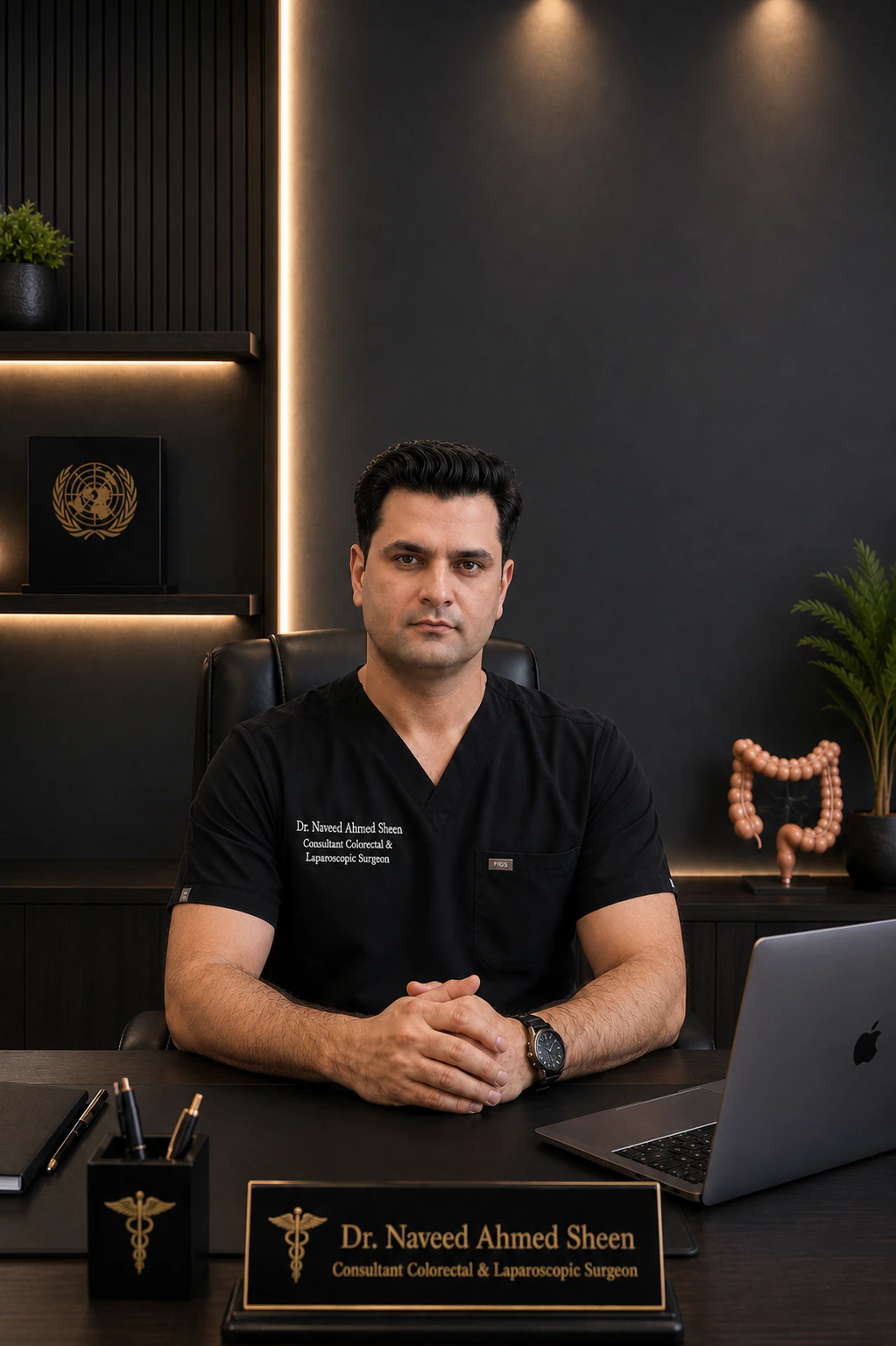
17 · Meet your surgeon
Dr. Naveed Ahmed Sheen
Consultant Colorectal & Laparoscopic SurgeonAssistant Professor and Major (Retired), combining 15+ years of surgical experience with academic teaching, military medical service and a patient-centred approach.
- MRCS · Dip (AFPGMI) · CHPE
- 1000+ successful surgeries
- 5000+ patients treated
Confidential surgical consultationDiscuss Tummy Tuck (Abdominoplasty)
Discuss Tummy Tuck (Abdominoplasty)
with Dr. Naveed
Bring your symptoms, reports and questions for a diagnosis-led discussion of appropriate options, benefits, risks and recovery planning.